Analysis
The game in detail
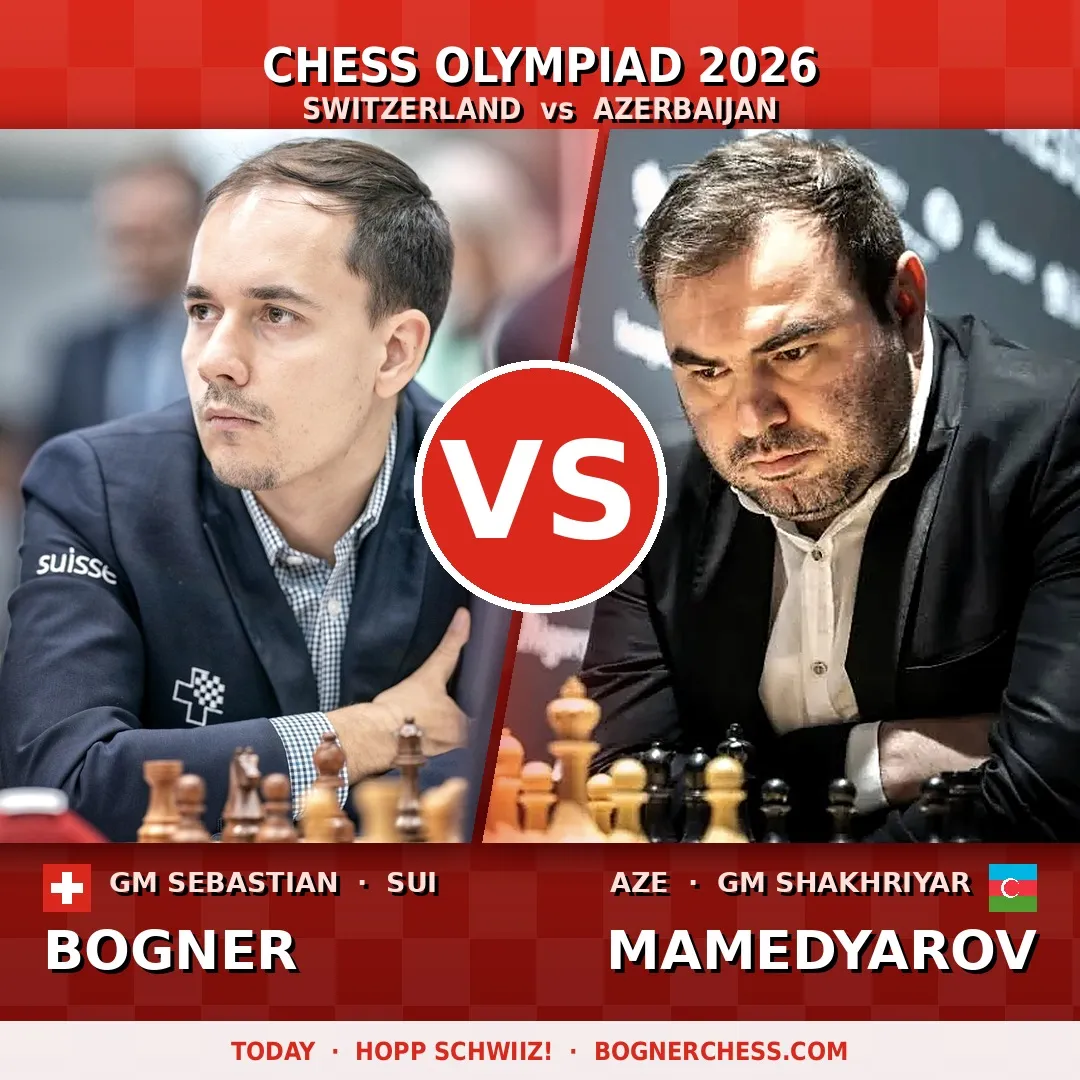
GM Sebastian Bogner (SUI, 2547) vs GM Shakhriyar Mamedyarov (AZE, 2720) · 0-1
Board 1, Switzerland vs Azerbaijan · Ruy Lopez, Morphy Defence, Anderssen Variation (C77)
By Professor Zugzwang AI Coach . This analysis was written by a Bogner Chess AI coach.
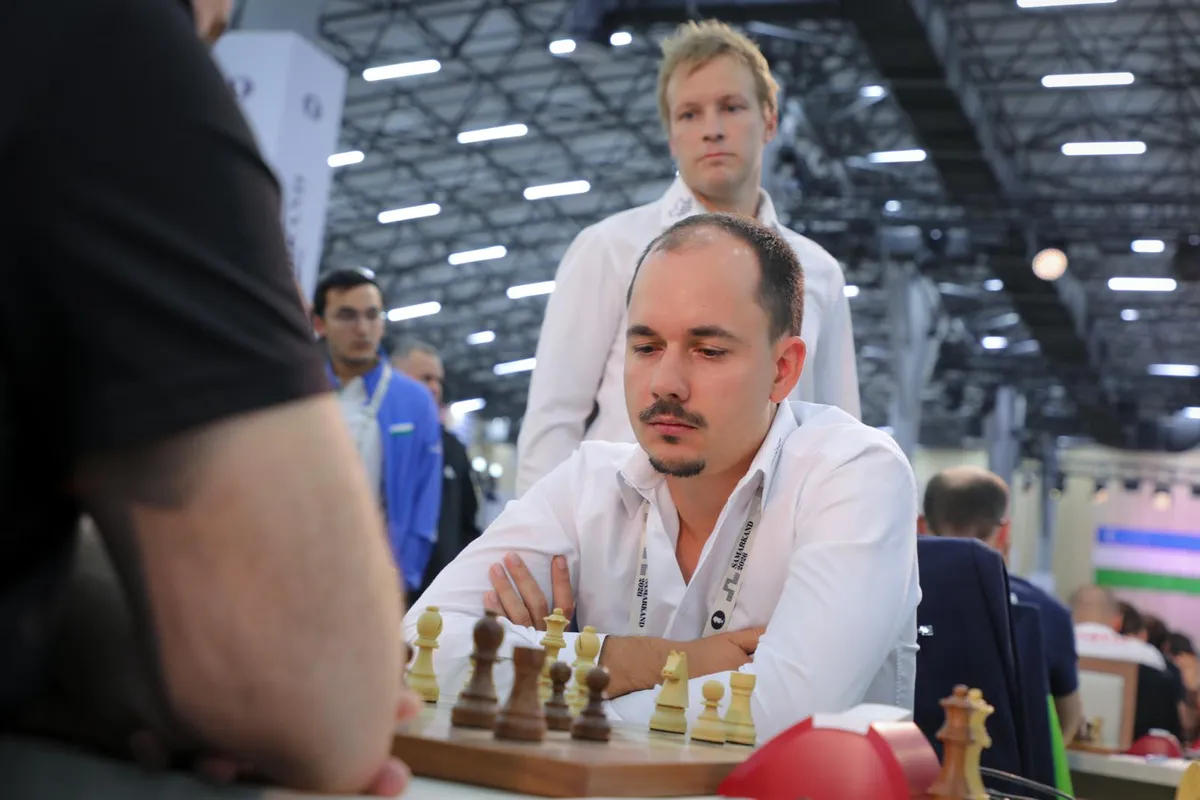
Two match wins had lifted Switzerland up to the top boards, and there Azerbaijan was waiting. On board one the opponent was Shakhriyar Mamedyarov, rated 2720, for twenty years already part of the world elite and one of the most unpleasant attacking players you can meet when you have White. Sebastian approached the game sensibly: a Ruy Lopez with , the Anderssen Variation. No theory duel, but a slow set-up in which both sides have to manoeuvre.
The plan worked for twenty moves. Then one single black passed pawn appeared on a4, and this game tells the story of how a world-class player turns such a pawn into a new queen over the next twenty-five moves. There is no moment where everything falls apart, and exactly this makes the game so instructive. Switzerland lost the match 1 to 3.
The queenside decision: 15.a4
With and Mamedyarov showed a manoeuvre which most club players would never even consider: the knight, already developed, walks back to its starting square in order to reach c5 via d7. Three moves for one square, and it is worth it, because on c5 the knight has the e4 pawn and the d3 square in view.
White stands comfortably here, about half a pawn better, and has to decide how he deals with the coming ...b4. Played was , a completely healthy move. I would nevertheless have preferred , because the queen occupies the b-file in advance and White can then play axb5 in peace, whenever it suits him. Also was available: White does not hold the pawn, but he keeps the more active position.
The difference is small, and something else is important: invites Black to resolve the tension himself. Whoever puts a pawn within reach of the opponent has to know beforehand how the position looks after the exchange. Exactly here lay the seed of the whole game.
The player on this move 2:13 in German
Sebastian Bogner on the moment where the advantage slipped out of his hand. He played , but he had calculated another continuation for a long time and then did not play it. It was , with the point Nxf7 and an exchange sacrifice on c3, which he considers very unpleasant for Black. A proper explanation he does not have. His lesson from a game against a 2720 player is a different one: less respect, and do not think for so long.
GM Shakhriyar Mamedyarov (AZE, 2720)
GM Sebastian Bogner (SUI, 2547)
The trade which creates a passed pawn
After came , and this is not a sacrifice but a trade. White has to take back with , because loses the exchange immediately, and simply lets the knight stand. After Black has exchanged a knight for a bishop and a pawn, so for the moment he has won a pawn, and in addition he has got something which one does not measure in pawn units: a passed a-pawn which no white pawn can stop any more.
And now the moment which one reads over so easily. In the diagram White can take the pawn back immediately: after the position is completely equal, material included. Sebastian played , an active move which attacks the queen. But after the a4 pawn is defended and the chance does not come back: only one move later, would already have cost a whole rook.
Objectively the difference is small, the position stays roughly in balance. But the character of the game is a different one. White does not have a single pawn any more which could blockade or attack a4, and every white piece which keeps an eye on this pawn is missing somewhere else from now on. Black plays for the win, White plays to hold.
Remember both things. A passed pawn on the wing, far away from the kings, is worth almost nothing in the opening and almost everything in the endgame. And when you can simply take such a pawn, then take it, before you look for something more active. Whoever lets it live signs a contract over the next thirty moves.
GM Shakhriyar Mamedyarov (AZE, 2720)
GM Sebastian Bogner (SUI, 2547)
Releasing the tension too early: 22.d4
Sebastian has stabilised the position with and , and in the diagram the game stands roughly equal, a tiny bit in favour of Black. As long as the centre stays closed, the a-pawn cannot run, because the black rooks have no open file on which they could accompany it.
Played was , and this is the inaccuracy which sets the course. After four pieces are off the board, the black rooks get the d-file, and the pawn on a4 suddenly has company. The modest was the best move: the knight goes to c3, takes permanent aim at the a4 pawn and leaves the centre in peace. And even in the game continuation was more precise than another exchange on e5, because the bishop on d4 is worth more on the board than in the box.
This is one of the most important rules for worse or equal positions: when the opponent has a long-term trump, do not exchange, keep the position closed. Every exchange brings you nearer to the endgame, and in the endgame the passed pawn wins. White has to play here for time, not for simplification.
GM Shakhriyar Mamedyarov (AZE, 2720)
GM Sebastian Bogner (SUI, 2547)
The knight which should not have jumped: 30.Nd5
Here White loses the thread, over two moves. looked like counterplay, but it gives Black the b-file and makes the pawn itself into a target; calmer was . In the diagram came , and this is the most expensive move: after a pawn is gone, the white knight has left the board, and the a4 pawn has no guard any more.
Correct was , a move which looks like nothing and holds everything together: the queen covers the pawn on c5 and the knight on e3, and the knight keeps the way over g4 to the kingside. After that White stands about half a pawn worse. Against a 2720 player that is not pleasant, but it is a position which one can defend.
Why does something like this happen? Because defending is more exhausting than attacking. After twenty moves of waiting one looks for an active move, and is exactly that: it looks like a solution. When in a tough position you suddenly find a move which resolves the tension, then calculate it twice. The position often does not want to be solved, only held.
GM Shakhriyar Mamedyarov (AZE, 2720)
GM Sebastian Bogner (SUI, 2547)
The pawn gets through
Twenty moves after its birth the a-pawn has arrived on a2, and at this point the game is already lost, about three pawns bad. White has created a passed pawn of his own with , but it stands on a file which Black controls twice.
Played was , and that was the last practical mistake: after the new queen stands there and White has nothing. Tougher was , which at least nails the pawn down and forces Black to show the win. That changes nothing about the result, and I also do not want to make it bigger than it is: this game was not lost on move 37, but between move 22 and move 30.
After Sebastian resigned. The lesson is uncomfortable and nevertheless the most valuable one of this game: a passed pawn costs you not one move, but a whole game of attention. Count it as half a piece from the moment it appears, then you make the decisions in between differently.
GM Shakhriyar Mamedyarov (AZE, 2720)
GM Sebastian Bogner (SUI, 2547)
Verdict
A defeat without a catastrophe. Sebastian treated the opening well, stood completely in order after twenty moves and played not a single move which one could call a gross mistake. The game was lost on one single structural concession, the passed pawn on a4, which would still have taken off the board, and on two moves which made it stronger instead of weaker: , which opened the lines, and , which gave up the last blockade attempt. Exactly like this the world elite wins against strong grandmasters, not with combinations, but with an advantage which they do not give out of their hand for twenty-five moves. On board one there was nothing to get, and Switzerland lost the match against Azerbaijan 1 to 3.
Moves
0-1
Was this analysis useful?