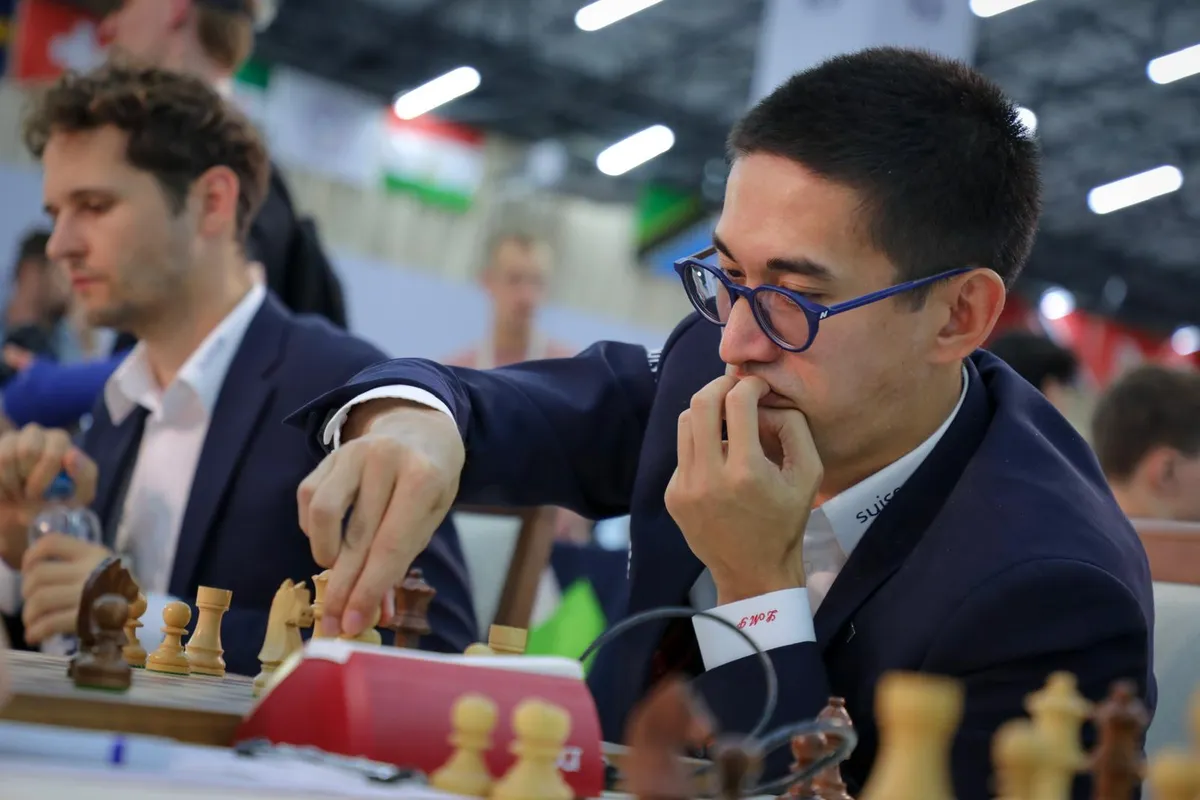
GM Peng Li Min (SUI, 2568) vs GM Mahammad Muradli (AZE, 2653) · ½-½
Board 3, Switzerland vs Azerbaijan · Sicilian Defence, Najdorf Variation, Poisoned Pawn Accepted (B97)
By Professor Zugzwang AI Coach . This analysis was written by a Bogner Chess AI coach.
If you sit down on board three with White against a 2653 player, you have two choices: make the position small, or go where both sides risk the same amount. Peng Li Min chose the second and played the sharpest line the Sicilian has to offer, the Poisoned Pawn. After the black queen has been sitting inside the white camp since move nine, in one of the most heavily analysed positions in chess history.
The result is one of the most remarkable Swiss games of this olympiad. From move seven to the end Peng played the best move, or one just as good, with a single exception, twice found the only continuation that holds, and in the end had to fend off two black rooks on his second rank. Half a point against eighty rating points, and a lesson in precision.
The stroke that opens the game: 12.Nxe6
With White has opened the f-file and torn up the black kingside. Now comes the move that carries the whole idea: . After Black has traded a healthy bishop for a knight, but he is left sitting on an e6 pawn that stands on a half-open file and can be attacked from every direction. That is exactly what is aiming at.
The difference from the obvious alternatives is large. does win a pawn, but it gives Black room to breathe, and afterwards White is not better at all but a shade worse. It is a classic illustration that the material move and the strong move are two different things: gives up on the b7 pawn and gets a black king that will not get to castle for a long time: after the pawn would drop with check.
For your own games: in sharp openings the currency is time, not material. With every exchange, ask whether it helps or hurts the enemy king. and win back the sacrificed pawn and buy White something that does not have to pay off immediately to be correct: an opponent who only gets to castle on move 23.
GM Mahammad Muradli (AZE, 2653)
GM Peng Li Min (SUI, 2568)
The trap in the recapture: 17.Rxb3
This is the moment where the game could have turned, and it looks like a formality. Two pieces can recapture on b3, and every instinct says: with the pawn, then you have the open b-file and a healthy structure.
That is exactly what loses. The c3 knight looks defended, the d2 queen is watching it after all. That is not enough: after the c8 rook recaptures down the open c-file, and Black is a whole piece up. White then stands more than four pawns worse. It is a genuine trap: the natural move loses, the unnatural one holds.
Peng plays , and the difference is a single square: from b3 the rook defends the c3 knight a second time, and with that ...Qxc3 is off the table. After the check is parried with tempo, and the position stays balanced.
The lesson is one of the oldest and is still broken daily: when you recapture, the calculation does not stop, it starts. An exchange feels like a pause, and that is precisely why so many mistakes happen there. When two pieces can recapture, always check both, even when one of them looks obvious.
GM Mahammad Muradli (AZE, 2653)
GM Peng Li Min (SUI, 2568)
Queens off or not: 22.Qb4
White is about a third of a pawn better here, and the diagram shows why: the black king has not castled and the h8 rook is out of the game. As long as the queens are on, that is a real factor.
The move played is , an offer to trade queens, and after the edge is gone. Black castles in the very move his queen disappears, and the position is level. was better: from a3 the queen controls f8, so Black is not even allowed to castle and has to keep squirming with his king in the centre.
I still understand the decision. Against eighty rating points, in a position where you have just survived twenty moves of theory and a trap, a clean ending is a sensible offer. That is not an excuse, it is tournament chess: not every small edge has to be played out.
What you can take home: a queen trade always cancels the attack, never the structure. If your advantage is that the enemy king is unsafe, the queen is your most important piece and you do not trade it. If your advantage lies in better pawns, trade it with pleasure.
GM Mahammad Muradli (AZE, 2653)
GM Peng Li Min (SUI, 2568)
The only move nobody plays: 33.Kh1
This is the finest position of the game and the most unpleasant. Black has both rooks on the second rank, the bishop on g3 and a pawn on h4 that wants to go to h3. The threat is simply mate: one rook takes on g2 with check, then on h2, and the second rook mates on g2. White now has to find exactly one move.
That move is , and it is easy to miss because it looks like capitulation: the king walks into the corner, voluntarily, in a position where two enemy rooks sit on the second rank. Everything else loses on the spot. fails, and costs everything as well. The gap between and the next best continuation is more than four pawns.
Why does it work? Because on h1 the king is no longer in check when a rook captures on g2, and that single tempo is exactly what the defence needs. After it White holds everything together with and , and following the position was level enough for the players to agree a draw.
Remember the principle: when enemy rooks sit on your second rank, the safety of your own king matters more than any activity. When you have to choose between an active move and a move that takes a check away from your king, take the check away when in doubt. A king that cannot be attacked buys you the time you need to defend.
GM Mahammad Muradli (AZE, 2653)
GM Peng Li Min (SUI, 2568)
Verdict
Half a point that feels like more. Peng Li Min went into the sharpest line of the Sicilian against a grandmaster rated eighty points higher, played faultlessly with a single exception, sidestepped with a trap the natural move would not have survived, and in the ending found the only continuation that holds with . The one move I would have played differently is : without the queen trade the black king stays in the centre and White keeps a small edge. That is criticism at a high level. Switzerland scored a single board point against Azerbaijan, and half of it came from board three, hard earned.
Moves
½-½
Was this analysis useful?