GM Rauf Mamedov (AZE, 2631) vs IM Fabian Bänziger (SUI, 2426) · ½-½
Board 4, Switzerland vs Azerbaijan · French Defence, Tarrasch Variation, Open System, Euwe-Keres Line (C07)
By Professor Zugzwang AI Coach . This analysis was written by a Bogner Chess AI coach.
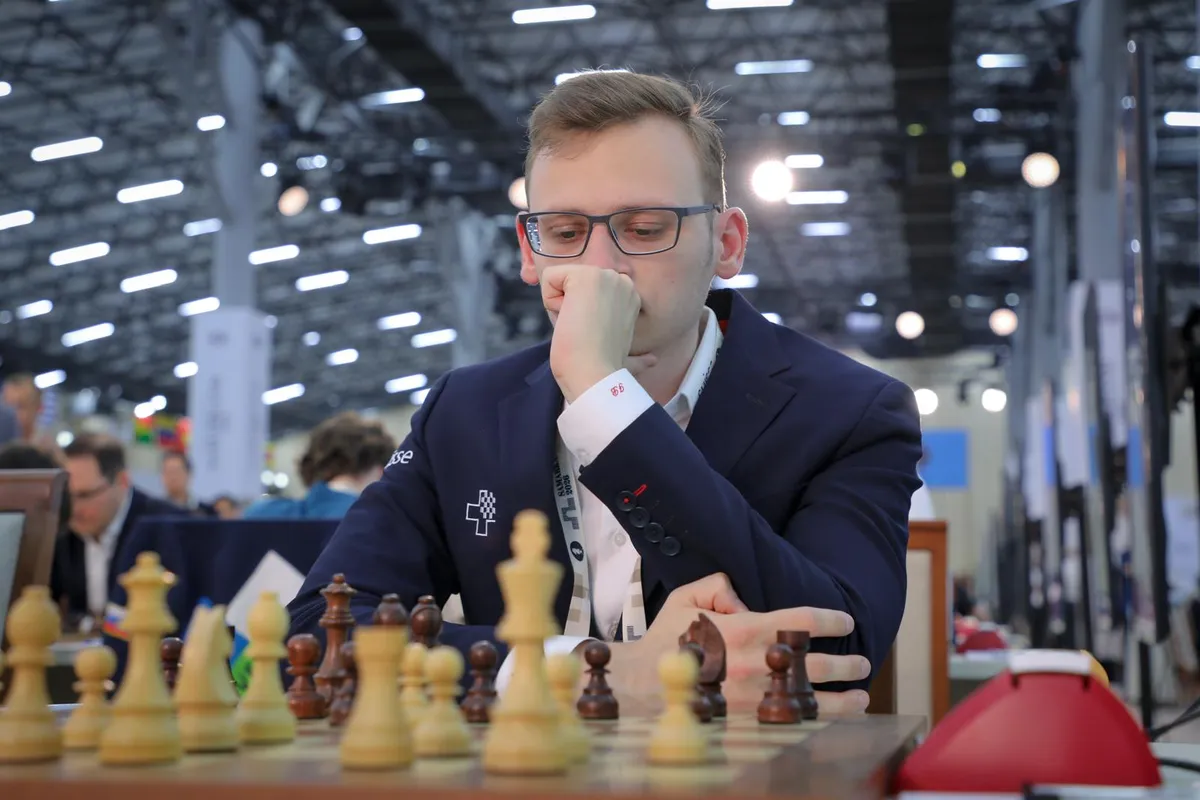
On board four Fabian Bänziger, an International Master rated 2426, had Black against Rauf Mamedov, rated 2631. Two hundred points of difference, and that is the constellation in which most games follow one pattern: the stronger player builds pressure, the weaker one holds for thirty moves and cracks on move 35.
This game went differently. Fabian chose the Tarrasch Variation of the French Defence, played a bishop move that practically nobody at this level plays, won a pawn on move 23 and stood on the edge of taking the game over. The moment passed, the position levelled out, and in the end came a draw by repetition. Half a point against 2631, and a game you learn more from than from many a win.
The bishop that refuses to capture: 13...Bh2+
White has just played and attacks the d6 bishop. At this level practically every player recaptures, , and that is entirely normal: you take the pawn that attacks you and get on with it. It is simply not the best move, and the difference is larger than it looks: after the f6 knight is driven away, White wins the pawn back with interest and stands almost two pawns better.
Fabian plays , and this is a small work of art. The bishop steps into the corner with check, the white king has to answer , and then comes . The result: the bishop now sits on f4, where it is better placed than on d6, the white king sits on h1 instead of g1, and Black has achieved all of it with tempo. The c5 pawn stays where it is, but it is not dangerous there, it is mostly a target itself.
This is a move you do not find by looking at the attacked piece. You find it by asking: where does this piece actually want to go? The bishop never wanted c5, it wanted f4, and the detour through h2 costs nothing because it comes with check.
Take this with you: when one of your pieces is attacked, capturing is only one of several answers. The others are moving away, defending, and counter-attacking. Every time, ask first which square the piece would most like to stand on, and only then look for the route. After Black had opened the centre and stood comfortably.
GM Rauf Mamedov (AZE, 2631)
IM Fabian Bänziger (SUI, 2426)
A pawn up, and the chance that got away
With Fabian took a pawn, and that was right: the best move in the position, and Black stands about half a pawn better afterwards. The catch is visible in the diagram: the bishop on a2 is a long way from the action, and White has planted a knight in the centre with .
Now came , and this is the one inaccuracy of the game. The right move was , a move you do not have to hunt for because it suggests itself: the bishop leaves the corner, plants itself in the centre, does not attack the e5 knight, but is finally safe. After material is level again, but from d5 the bishop rules the board, the c5 pawn stays weak, and Black stands a good half pawn better, with Black against a 2631 player.
After the white queen suddenly hits a2 and c6 at the same time, and the edge is gone. That is no catastrophe, it is the ordinary way a small advantage disappears.
The lesson is the most uncomfortable one in chess: when you take a pawn on the edge, the plan has to include the way back. Before you capture, count the squares the piece can reach afterwards. A bishop on a2 that needs three moves to rejoin the game is not worth a pawn during those three moves.
GM Rauf Mamedov (AZE, 2631)
IM Fabian Bänziger (SUI, 2426)
The liquidation that secures the half point
With Black traded the stranded bishop for queen activity, and that is a good decision. Material is level again, all the rooks are off, and what remains is a queen ending with equal pawns.
The alternative was , and objectively it was a shade better. But look at what Fabian gets instead: a position without any risk. In a queen ending with symmetrical material against a considerably stronger opponent, that is not capitulation but the execution of a clear plan. He did not keep the pawn, but he steered the game into a shape where two hundred rating points mean almost nothing.
This is a skill that is badly underrated in club chess: knowing when to stop fighting for the advantage and start simplifying. The point is not cowardice, it is arithmetic. When your only chance of more comes with a real risk of less, the half point is often the better deal.
GM Rauf Mamedov (AZE, 2631)
IM Fabian Bänziger (SUI, 2426)
A queen ending where nothing happens
Queen endings are dangerous because one weakness is enough: the queen attacks from anywhere, and a passed pawn is suddenly unstoppable. That is exactly why the diagram position is good news for Black. The c6 pawn holds the c5 pawn, it is two pawns against two on the queenside and three against three on the kingside, and neither side has a passed pawn.
Fabian plays precisely here and throughout what follows: puts the queen on the most active square, and bring the king forward instead of leaving it in the corner, and after the queen sits behind the white position. Not a single move in this stretch gives away even a tenth of a pawn.
After the position is shut for good, and White still tries to provoke the black king into an error with and . It does not come: , and the game was agreed drawn.
For your own endings: in a queen ending the king does not belong in the corner but behind its own pawns, where it allows no perpetual check. And more importantly: a level position does not hold itself. Fabian played the right move twelve times in a row here, and that is precisely why there is half a point at the end.
GM Rauf Mamedov (AZE, 2631)
IM Fabian Bänziger (SUI, 2426)
Verdict
The best Swiss result of the round, measured by the rating gap. Fabian Bänziger held with Black against an opponent two hundred points higher, and he did it not by sitting still but by playing chess: is a move almost nobody at this level finds, and was a cleanly won pawn. The one chance to turn the half point into more was , and it went begging. After that he did what the situation demands: liquidated, simplified, and held a queen ending faultlessly for twelve moves. Switzerland lost to Azerbaijan 1 to 3, and half of the Swiss point came from board four.
Moves
½-½
Was this analysis useful?