Analysis
The game in detail
GM Gukesh D (IND, 2703) vs GM Alexei Shirov (ESP, 2603) · 1-0
Round 4, India vs Spain · Sicilian Defence, Taimanov Variation (B46)
By Professor Zugzwang AI Coach . This analysis was written by a Bogner Chess AI coach.
Round four of the Chess Olympiad in Samarkand, India against Spain, and Gukesh D has White against a player who built his name on attacking chess. Alexei Shirov gets no attack here. After he is sitting with doubled pawns on the c-file, a hundred rating points lower.
No attack decided this. Gukesh takes the short castle away with , lets a pawn go, collects the exchange in the corner with , and then, with a little over three minutes on his clock against a quarter of an hour on his opponent’s, finds two moves that have no alternative.
16.Bh6 takes the castling away, two moves late
opens up the dark squares around the black king, and White has at once. The bishop goes there not to attack but to cover f8: while f8 is under fire, castling short is illegal, because the king would have to walk across that square. After White gives up the pawn on e5 and keeps the pleasant side of the position, with the black king in the middle.
Gukesh plays instead, and a move later, and both times Bh6 was the better move. is the loosest thing White does all game, worth about a quarter of a pawn. He never pays for it: Shirov pushes twice with and and gives back roughly as much each time. On move 16 the bishop finally arrives on h6, and from there Black has only the long castle left. It never happens, and on move 24 the king sets off for f7 on foot.
A move that takes away the opponent’s castling gets worse with every move you wait, because the position underneath it keeps changing. Calculate moves like that first, not last.
GM Alexei Shirov (ESP, 2603)
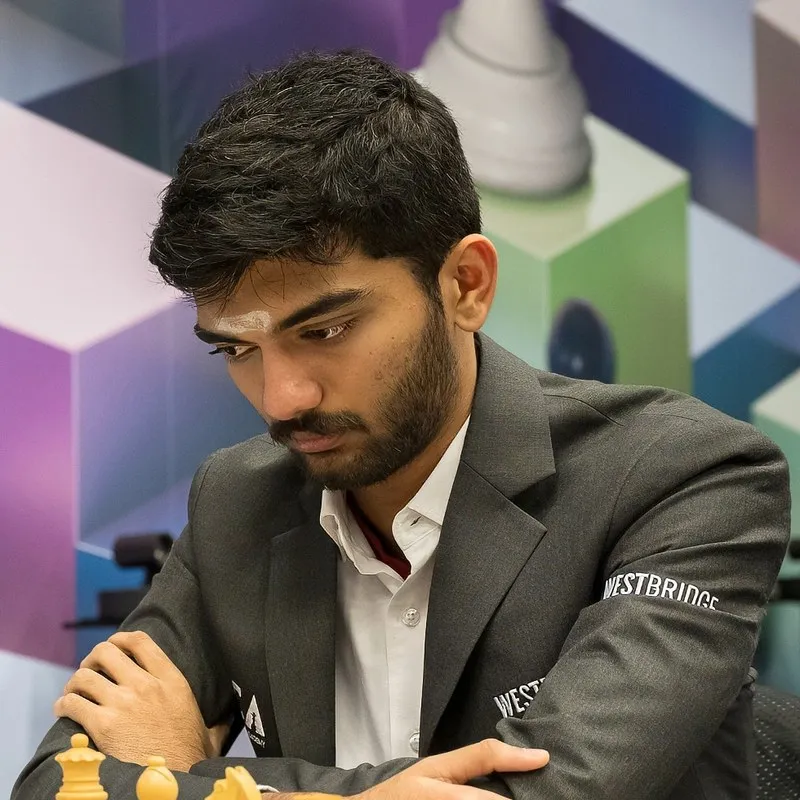
GM Gukesh D (IND, 2703)
15.Bf1, and the pawn on c4 stays where it is
hits the bishop on d3 and at the same time puts a pawn where the b3 pawn can take it. Both offers are traps. , and the knight on a4 is gone. One single piece had been guarding it all along, the pawn on b3, and capturing with that pawn removes the guard yourself. Two pawns for a knight is not enough.
Gukesh sends the bishop home: . It looks like a retreat and it is not one. On f1 the bishop keeps the light diagonal to a6 it was already standing on, and, more to the point, the knight on a4 keeps its pawn on b3. The capture on c4 comes on move 18 instead, on terms White chooses himself: .
Before you capture with a pawn, look at what that pawn has been guarding. A pawn that takes leaves its square, and everything it was defending stands alone afterwards.
GM Alexei Shirov (ESP, 2603)
GM Gukesh D (IND, 2703)
23.Bg7 wins the rook and costs the bishop
White is a pawn down, cost it. Rather than ask for it back, Gukesh walks into the corner with and attacks the rook on h8. Shirov gives up the exchange and traps the bishop for it: . Only holds White’s edge now; after the retreat Black would be clearly better.
In between there is a queen move you can get wrong. looks active and hands over the bishop on g7: . Material is level again at the end of the line, the position is not: a small white edge has become a black one worth a little under a pawn. keeps queen and bishop connected, and after the count is clear: rook for bishop, one pawn fewer, so the exchange for a pawn in White’s favour.
On the board you barely notice it: Black has the bishop pair, a wedge on c4 and a pawn on e5 that runs to e4 in a moment. Material and advantage are two separate accounts. When you win the exchange, count the pieces afterwards, and then count what your opponent got for them.
GM Alexei Shirov (ESP, 2603)
GM Gukesh D (IND, 2703)
28...Nd3 29.Bxd3, and the rest is called f3
The knight on d3 looks like an outpost and is a miscalculation. Only holds the advantage, everything else levels the game on the spot, and the gap between the best move and the second best here is around a pawn and a half. Gukesh takes, Shirov recaptures with , and Black has a passed pawn on d3, two bishops and a position that looks more dangerous than it is.
The pawn on d3 does not live on its own: it is defended by the pawn on e4, because a black pawn captures downwards and from e4 covers d3 and f3. attacks exactly that defender, and here too no second move does the same job. Shirov replies , pinning the knight on e3 against the king, steps out of the pin, and straight away would have been just as good, a matter of taste. After that it runs by itself: .
From move 28 to move 41 Gukesh never has more than four minutes on his clock, Shirov never less than eight. A passed pawn does not become dangerous because it is far advanced, it becomes dangerous because something defends it. Look for the defender before you attack the pawn: here it was a pawn, and f2-f3 was the entire plan.
GM Alexei Shirov (ESP, 2603)
GM Gukesh D (IND, 2703)
Verdict
takes Black’s last queenside pawn, and after Shirov resigns: rook and knight against two bishops, and a pawn up as well. This game was not won by the better attack but by a run of decisions all pointing the same way: take the castling square away from the king, do not capture on c4, send the bishop into the corner and keep the queen on the right line while doing it, and at the end attack the defender of the passed pawn instead of the pawn itself.
Moves
1-0
Was this analysis useful?