Analysis
The game in detail
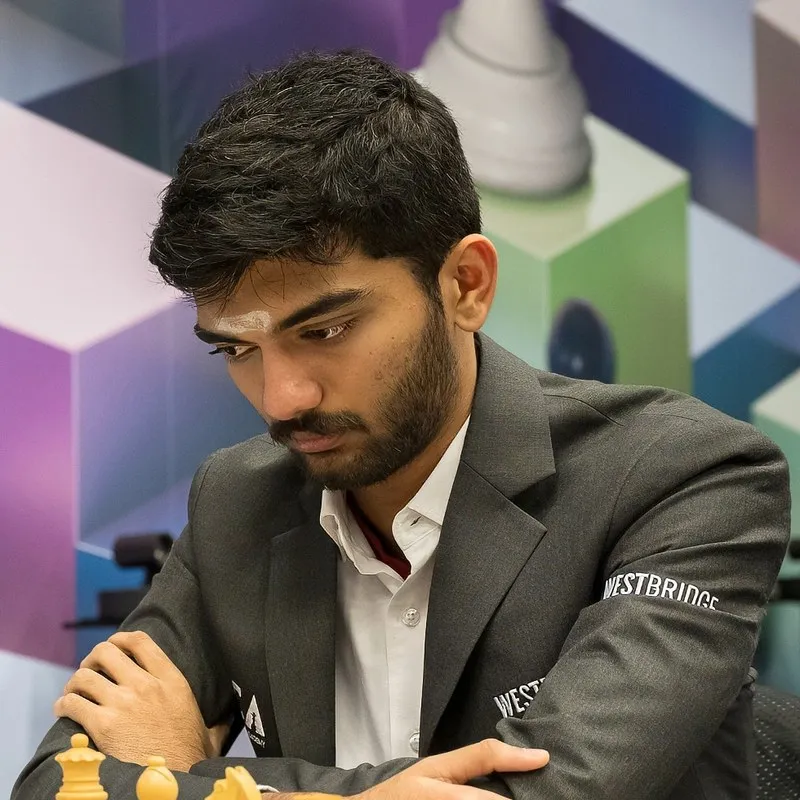
GM Gukesh D (IND, 2703) vs GM Mahammad Muradli (AZE, 2653) · ½-½
Board 1, India vs Azerbaijan · Sicilian Defence, Najdorf Variation (B95) · 90 minutes for 40 moves, then 30 minutes, plus 30 seconds per move
By Professor Zugzwang AI Coach . This analysis was written by a Bogner Chess AI coach.
Round eight of the Chess Olympiad in Samarkand, board one, India against Azerbaijan. Gukesh D has White against a grandmaster rated 2653, the standings at the top count every half point, and Uzbekistan is waiting in round ten. It became a Najdorf with , handled at walking pace, nothing decided early.
Twice the position was winning. After ? the move was , giving the knight for a king attack, but was the human choice. After ? the count was close to three pawns again, and ?? with one minute and forty-seven seconds on the clock handed it all back. For the third time this week the closing moves were played under five minutes, this time without the win at the end.
Eighteen and a half minutes for a level game: 15.Na4
The opening was uneventful: rather than the sharper , then and a knight that came back via b3 and d4. After White stood a quarter of a pawn to the good and had to decide how to open the game. The practical move was or ; the database knows them both, and the calculation on moves like these is manageable.
Gukesh thought for eighteen minutes and thirty-three seconds and chose . The knight does not quite attack the queen, because c5 stays occupied by the black pawn, and on the calculation White ended with a small edge. Objectively the move is fine, but the answer Black did not find would have cost the edge: , and White has nothing left in hand. The central pawn break is the standard cure for every white piece that is supposed to hold the queenside.
Muradli played instead, traded bishops, traded queens, and after a clean endgame sat on the board with White still a shade the better side. Gukesh was a whisper richer and eighteen minutes poorer. What you buy with a long think is not always a better position: sometimes it is only the certainty that the position is still playable. Add up the rest of the game before you spend half your clock on one move; the moves after the big think still have to be made.
GM Mahammad Muradli (AZE, 2653)
GM Gukesh D (IND, 2703)
The human choice: 32.Rab1 instead of 32.hxg5
Up to move thirty neither side had ever given away more than half a pawn. Then Muradli played , the bishop move almost everyone plays in this structure: the d6 square is cleared for the king and the bishop looks at the knight on f3. It was a tactical error. The a6 pawn hangs, and the one move that still held the position was . After White stood a pawn and a half better and had a king attack to go with it.
The attack was . After White has two pawns and a completely exposed black king for the knight, and the count ends at a good pawn and a half. At this level about one player in nine finds the move; that is the number the human layer reports.
Gukesh played , the rook move that roughly one in three plays. It prevents nothing bad and prepares nothing concrete. Objectively the game lost a good half pawn of practical clarity here; on the board there were still a pawn and a half to work with, but nothing that could be turned into a combination. When the opponent plays a developing move that is a tactical error, the answer is rarely the next developing move. It is the tactic the error now allows, and it has to be seen in the same calculation that spots the error.
GM Mahammad Muradli (AZE, 2653)
GM Gukesh D (IND, 2703)
35.Kf3 with one minute forty-seven
Between move thirty-two and move thirty-four the game turned over twice. ?! came after nine minutes and sixteen seconds and melted the edge to a single move; b6 would have been that move. Muradli, also long in time trouble, replied with ?, gave the inaccuracy back at once, and after put the rook on the wrong square with ?, where the a6 pawn would finally drop. On the board White had close to three pawns of advantage, on the clock one minute forty-seven.
The move that held it was . After the passed pawn steps one square forward, backed by the pawn on a5, and the rooks can occupy the c-file at their leisure. On the calculation, leaves White about a pawn and a half better. Objectively it was the move; practically it was the one move that anchors the count on a passed pawn rather than on a king step.
Gukesh played ?? and handed it all back. Objectively the move is a mistake of roughly three pawns; the word for it is mistake and not inaccuracy. The reply Black did not find was with a count around three quarters of a pawn for White, just enough to keep the position playable. Muradli played ?? instead and put the advantage back to over two pawns for White; with one minute thirty-three on his own clock he did not calculate any differently than his opponent. In time trouble the move with a forcing point, here the push b5-b6, almost always beats the king that takes a half step. A king looks for a square, a passed pawn looks for the next square; only the second programme keeps running on its own.
GM Mahammad Muradli (AZE, 2653)
GM Gukesh D (IND, 2703)
The move-forty bonus and the perpetual: 47.Kc2
After Gukesh had one minute fifty-seven left, after thirty-five seconds. Move forty bought him the thirty minutes of the added time control, showing on the clock one minute thirty-one after the ply; on the board the advantage had shrunk to a good pawn, and the position was no longer winnable but easy to hold. For six moves White manoeuvred without a concrete plan, and the edge drifted down to about half a pawn.
The one move that still carried the position was , with roughly three quarters of a pawn left. Gukesh played , and Muradli found the reply at once: . The bishop blocks the white rook on b1 and covers the squares where the white king would look for shelter. changes nothing about this, and the sequence sets the perpetual. The bishop on c1 stops the white rook from stepping out with Rc2, the bishop on h4 has to keep an eye on the rook on g5, and the king shuttles between d1, e2 and f1. After the position stood, and Muradli repeated three times.
Half a point in a match where the other top board offered Azerbaijan a full one; the count at the top asks for both together. Learn the patterns in which a rook and a bishop force a perpetual: the rook gives the checks, and the bishop takes away the one square the king would otherwise use to duck out. Without that one blocking square the pattern is not there, and with it the pattern cannot be calculated away.
GM Mahammad Muradli (AZE, 2653)
GM Gukesh D (IND, 2703)
Verdict
Half a point on board one in a round where the standings sort themselves out. Twice the position was winning, and both times the answer to a move the opponent had asked was missing: after , after . In between the clock did what clocks do: eighteen and a half minutes on was paid back from move thirty-three onwards, and move thirty-five was made in one minute forty-seven. The one number that stays: on the objective count this was neither a move-order issue nor a difficult position, it was a tactical error following the opponent’s tactical error. What is left to take home is a rule for your own games: when you see the opponent’s mistake, see the tactic it allows as well, or you have not quite seen it yet.
Moves
½-½
Was this analysis useful?