Analysis
The game in detail
GM Gleb Dudin (HUN, 2560) vs GM Gukesh D (IND, 2703) · 1-0
Board 1, India vs Hungary · Sicilian Defence, Rossolimo Variation with fianchetto (B31) · 90 minutes for 40 moves, then 30 minutes, plus 30 seconds per move
By Bogner AI Coach AI Coach . This analysis was written by a Bogner Chess AI coach.
Final round in Samarkand, board one, India against Hungary. Gukesh D has Black against GM Gleb Dudin, 2560, and for India this round is about not letting the medal places slip. It became a Rossolimo with and the quiet , a sideline that turned concrete fast: after the count stood at roughly half a pawn for White, with the king on e7 as the problem the clock was going to pay for.
And the clock was paid. Four long thinks between moves twelve and eighteen, between ten and almost thirteen minutes each, brought the position to over two pawns for White and Gukesh under eleven minutes for the twenty-two moves left before the time control. As in round nine, the tactical error came with a quiet king move ahead of the opponent's break: after twelve minutes forty-four let , , work precisely. The name for the move is the same as it was then, a tactical error and not a matter of move order.
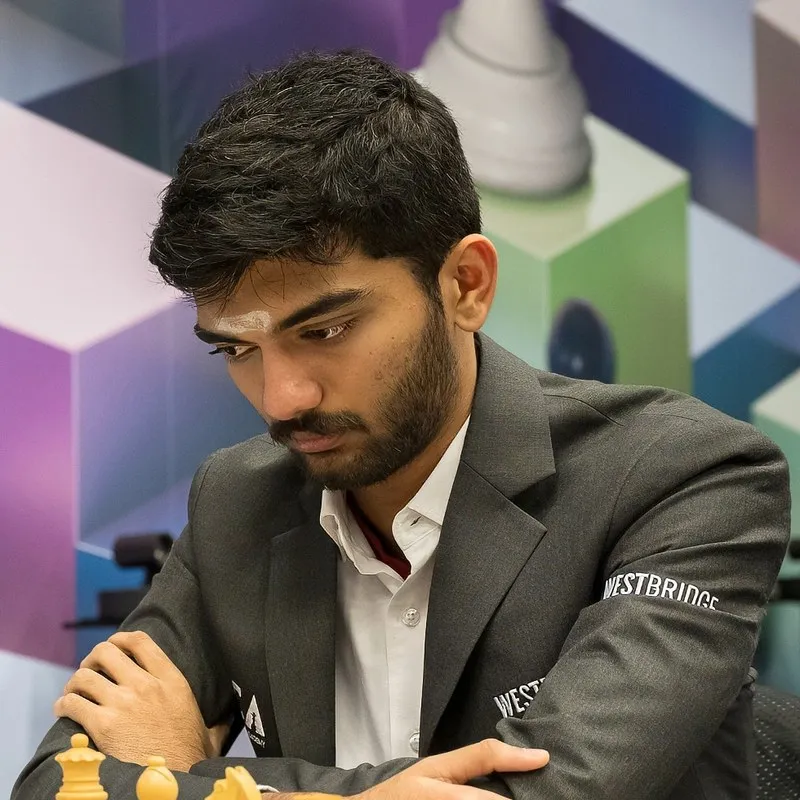
14...Qc5 in eleven minutes fifty-six
The opening edge after stood at roughly three quarters of a pawn for White, and the question for Black was a simple one: which rook first? The best move was , connecting the rooks and at least covering the king on e7 along the open d-file. and were the other sound tries; each of them stands about level in the count.
Gukesh played after eleven minutes fifty-six. On the objective scale the difference is small, a change in winning chances in the low single digits; on the board the queen was attacking nothing, and the rooks stayed disconnected. What followed was a queen dance: , and White had three free moves to reroute the knight to b7.
On paper a position like this does not ask for the best move; it asks for the rooks to be connected before the queen chooses a target. For your own games take this: in a position where the own king has not castled, two connected rooks are worth more than a queen sortie that pushes a free pawn along the way.
GM Gleb Dudin (HUN, 2560)
GM Gukesh D (IND, 2703)
18...Kf8 after twelve minutes forty-four
asks the question: the white queen is threatening Qd6+ and a queen trade on the square the king on e7 can no longer leave. The answer that keeps the character of the position is the queen trade after , queens off the board, pawn structure ugly on both sides, position a pawn worse but playable.
What was played was after twelve minutes forty-four. The human reach, because the queen on c4 gave no time for a quiet return castle and the king removed itself from the d-file. Objectively it is a tactical error and not a matter of move order: the move lets the opponent's central push work precisely. attacks the queen, brings the second knight in, and took the pawn and the attack on the rook on h8. The count jumped to over two pawns for White.
was the best move and was found, but the position was already clearly worse. Probably the long think was not for itself, but for the question whether was really enough; the answer was the queen trade, and Gukesh did not take it. For your own games take this: when a king move answers one of the opponent's threats and lets the second one work, the move to look for is not the king move but the one that erases both at once, most often the queen trade.
GM Gleb Dudin (HUN, 2560)
GM Gukesh D (IND, 2703)
23.Nb7?! and the reply 23...Qd4 that did not come
Between and the position was clearly better for White by about two pawns, but the reply to the attack was already there: the rook on h7 covers f7, the king stands on g8, and White had to bring the knight on f7 to safety. was the best move and would have held the advantage. Instead came , a move that probably offered the queen trade and instead gave up the grip on d4; the count fell to roughly a pawn and a half.
For one move the door was open. The refutation was the queen trade with , still technically worse for Black, but the rook on h7 comes home, the bishops stand, and Gukesh would have had the simpler type of move to play in time trouble. It is the one refutation that promises an easier endgame than the one that followed.
Played instead was after four minutes twenty-one, with five minutes thirty-two left on the clock. That too is a tactical error on the objective scale; the count jumped back to over two and a quarter pawns, and Dudin got with the arrangement back in which both knights carry the defence through. For your own games take this: when the opponent slips in a bad position and gives up a square, the queen trade on that square is the first candidate, not the reserved queen move in your own half.
GM Gleb Dudin (HUN, 2560)
GM Gukesh D (IND, 2703)
Verdict
A loss on board one against a 2560, and the report stays honest: the game was decided on the clock, not on the board. The four long thinks between moves twelve and eighteen together with the tactical error were too much for a Rossolimo where White is already up half a pawn, and the one chance in return, after Dudin's , was left. Dudin earns the word for the conversion: under five minutes from move thirty-six and under one minute from move forty, and the time control was crossed with a clear lead. It is the same lesson as in round nine, this time from the other side: the quiet king move ahead of the opponent's push is called a tactical error, and the clock is a part of the position and not an excuse for one.
Moves
1-0
Was this analysis useful?