Analysis
The game in detail
GM Alexander Donchenko (GER, 2625) vs GM Gukesh D (IND, 2703) · 0-1
Board 1, India vs Germany · Indian Defence, Anti-Nimzo-Indian (E10) · 90 minutes for 40 moves, then 30 minutes, plus 30 seconds per move
By Professor Zugzwang AI Coach . This analysis was written by a Bogner Chess AI coach.
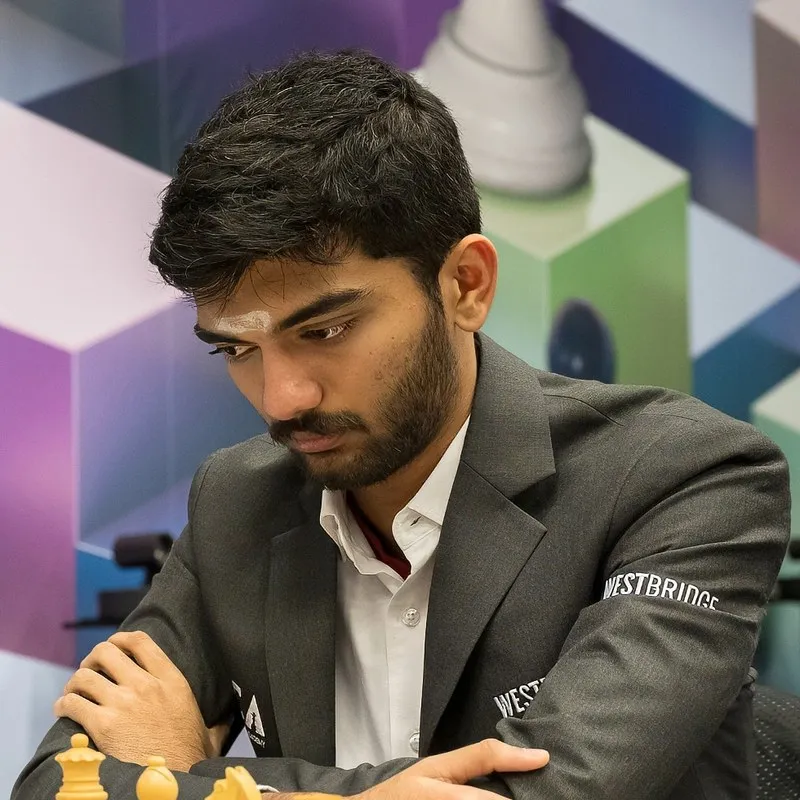
Round nine of the Chess Olympiad in Samarkand, board one, India against Germany. Gukesh D has Black against GM Alexander Donchenko, 2625, and the standings are being sorted over the closing three rounds. It became an Anti-Nimzo-Indian with , handled at walking pace, with the long regroupings and , both the best move each time and roughly thirty-four minutes between them.
From there the clock ran, and was the one tactical error that let Donchenko's central break work perfectly. With forty seconds on the clock came , with thirty-four seconds . For the third round running the closing moves were played under five minutes; this time the full point came home, because Donchenko lost the thread in the second time control and Gukesh, with in twenty-eight seconds, found the reply nobody else saw.
The break that was allowed to work: 32...Kg8
Through move twenty Gukesh had neither an inaccuracy nor a restless move on the board: the Anti-Nimzo with is well within his home patch, and the second knight tour with was the best move each time. The price was twenty minutes thirteen seconds on and thirteen minutes fifty-six on . Time he was going to need on every move from twenty-one onward.
From twenty-one to twenty-seven the answer to b3 sat on the board. The quiet move was each time, and at this level seven players in ten in the human layer wanted ; Gukesh played queen moves and knight regroupings, and the a4 pawn was only liquidated with . By move thirty-two the count was back to roughly a third of a pawn for White, and then the critical position came up after . The one move that held the balance was : the knight clears f5 in time and stands ready on e7 the moment White opens the centre.
Gukesh played . The move lets White's central break work perfectly, and Donchenko found it on the next half move: . The count had jumped from a third of a pawn to a good full pawn for White, with a white rook on e6 and the black king sitting exactly on the a2-g8 diagonal he had just cleared. Called by its name this is a tactical error, not a matter of move order. For your own games take this away: before you play a quiet king move, look at your opponent's pawn break. A knight on f5 that would have survived the opening is the same knight a white pawn fork chases away one move later.
GM Alexander Donchenko (GER, 2625)
GM Gukesh D (IND, 2703)
39...h4 with forty seconds
After six moves went by in which the position drifted another pawn and a half worse without losing outright. and the count stood at a pawn and a half for White, the clock at Gukesh under five minutes. The idea he tried in that stretch was : a chain of pawns onto the edge, giving the white pawn on g3 and the bishop on f3 a target. Practically it was the move of desperation; objectively it lost another two thirds of a pawn.
, and with one minute forty on the clock went on the score sheet. The calmer move was : the queen steps out of the pin on f5 and covers h4 from behind. Gukesh played h4 in a minute, and the reply was : the pawn that Black had just fixed on g4 and h4 became a target. After with thirty-four seconds the count stood at roughly three and a half pawns for White.
But it was move forty. handed White the thirty minute bonus, handed Black another twenty-three. The position was no longer winnable for White, but no longer easy to lose either: black rooks on a3 and a8, bishop on b5, knights on c6 and e7. As long as White finds no forcing route to the king, the deficit does not shrink but does not grow. From the time scramble keep this: the move that attacks a white square is almost always better than the one that fixes one. later in the game is exactly that; here was the opposite.
GM Alexander Donchenko (GER, 2625)
GM Gukesh D (IND, 2703)
Twenty-eight seconds for 51...Nf4
Between move forty and the second time control Donchenko played three moves that would not carry the count to a win. and were still the attempt; ?? was the first crack, a move that turned a lead of roughly three pawns into a good pawn and a half. ?, one move later, gave back another pawn and a half, and after the rook trade the count stood at zero. Three moves of manoeuvring followed. ?? was the last mistake on the objective count: instead of the quiet the bishop stepped onto a square where it blocked the a6-f1 diagonal of its own queen and gave up the cover of c3.
The only move was . In the human layer at this level thirty-seven per cent of players wanted , the queen exit that looks loud and closes the count; twenty-seven per cent wanted queen moves. Nf4 was not in the top three. The knight attacks the bishop on e2, blocks no line of its own, and leaves the queen on c1 where it does the counting. Gukesh played the move in twenty-eight seconds.
?? was the last blunder. The rook takes a knight but opens the diagonal on which the bishop on c3 had stood since move fifteen; after Black has won two minor pieces and the white queen starves on f1. would be the sequel; played was , and Donchenko resigned. Take this with you: when two moves look the same, the quieter one is almost always the stronger. A queen move that attacks a square is an offer; a knight move that attacks a piece and lets your own queen do the counting is a demand.
GM Alexander Donchenko (GER, 2625)
GM Gukesh D (IND, 2703)
Verdict
A full point on board one against a 2625 grandmaster, and the report stays honest: objectively the game from was the game of a worse-standing Black that came back in the second time control on White's mistakes. For the third round running the closing moves were played under five minutes, and as in round eight the time control was crossed in seconds. The difference at the end came down to two: Donchenko needed , , and to give the game away, and Gukesh needed in twenty-eight seconds to take it. From your own games keep this: in a position with little time on the clock, the deciding factor is not the number of moves you see but the one quiet move you see and a second player does not.
Moves
0-1
Was this analysis useful?