Analysis
The game in detail
IM Satria Duta Cahaya (INA, 2412) vs GM Gukesh D (IND, 2703) · ½-½
Round 2, India vs Indonesia · Sicilian Defence, Kan Variation, Maróczy Bind, Réti Variation (B41)
By Professor Zugzwang AI Coach . This analysis was written by a Bogner Chess AI coach.
Round two in Samarkand, Black against an opponent rated 291 points lower: the assignment where a team leader can only lose. IM Satria Duta Cahaya answers with the Maróczy Bind, the structure with pawns on c4 and e4 that takes Black’s space away and hands him no weakness in return.
Fifty-one moves later the scoresheet says draw, and Gukesh has not played a single move in the game that deserves to be called a mistake. He never had an advantage either. Against a sound structure, sound play is not enough. You need the break.
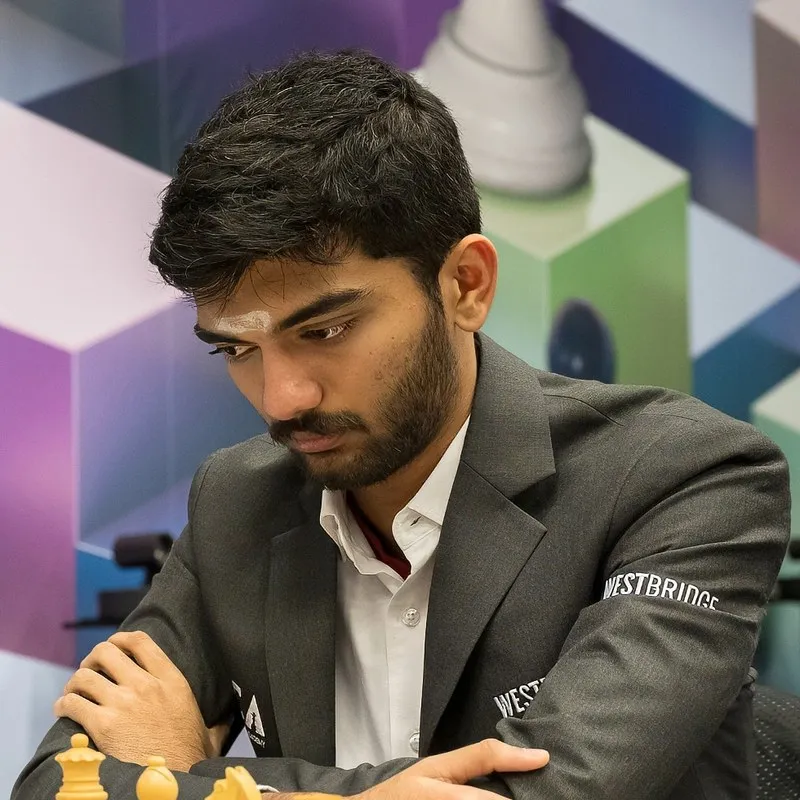
A position with no weakness and no break
The Kan with invites , and that is the Maróczy Bind: two pawns on c4 and e4 take the squares b5 and d5 away from Black. In exchange Black gets a sound structure with no weakness, but he has to live with a pawn on d6 on a half-open file. Both and are fine, and the difference between them is a matter of taste.
Gukesh answers the space problem with a knight tour: and then, by way of a detour, . Almost nobody at this level plays that, and objectively it costs nothing. From g6 the knight covers h4, which is exactly where the pawn is heading: and take the g3 square away from the white knight.
Swapping the dark-squared bishops with does cut White’s edge down noticeably, and what it does not bring is more than breathing room. The side that is squeezed improves the pieces first, then trades off whatever is doing the squeezing.
IM Satria Duta Cahaya (INA, 2412)
GM Gukesh D (IND, 2703)
The break that never came: 33...b5
Against the bind Black has exactly two breaks, ...b5 and ...d5, and here is the right one. It works tactically: wins the pawn straight back, and with the c4 pawn gone the whole bind goes with it. If White sidesteps with , a small white edge remains, but the position is open and Black has counterplay.
What was played is , and with it the bishop continues a round trip that started at : b7, c8, d7, c6 and back to a8, five moves in which nothing about the position changes. Almost nobody at this level finds , and the reason is human: the break puts a pawn out of your hands for two moves, a bishop move puts out nothing.
In a blocked position the break is not a move, it is the entire plan. Postpone it and you hand your opponent the choice of when the position opens.
IM Satria Duta Cahaya (INA, 2412)
GM Gukesh D (IND, 2703)
Six minutes, and the break goes unplayed: 38...e5
With White lets go of the small edge he has nursed all game: for the first time Black is not worse but a shade more comfortable. After the a-file is open too, and the second break is there: opens the position at the right moment. After or Black has no worries left.
Eight and a half minutes are left for the three moves to the time control. Gukesh spends more than six of them and plays , a healthy move that puts the rook on the open a-file. The difference to is around a third of a pawn, so nothing dramatic, but it hands the moment back to White and leaves two minutes for the last two moves before the control.
And White takes it: . The position opens on his terms now, and Black has to calculate instead of plan, with two minutes for two moves. A long think pays off where the structure changes. Here it went into a piece move, and the two minutes that were left had to carry the two hardest moves of the game.
IM Satria Duta Cahaya (INA, 2412)
GM Gukesh D (IND, 2703)
The move that holds: 39...Ra3
Gukesh finds and comes out of it with 59 seconds on the clock. It is the one move that keeps the balance. The rook breaks into the third rank, hits the bishop on d3 and forces White to deal with it.
The natural move would have been , simply taking the pawn back. After the material is still level, but White is clearly better: Black’s kingside pawns are ruined and the knight is handed the squares e5 and g6.
White goes for the trade, and after a pair of rooks is off and the material is level. In defence the order matters: activate your own rook first, then capture.
IM Satria Duta Cahaya (INA, 2412)
GM Gukesh D (IND, 2703)
How to force a draw
is not forced, there are two equally good alternatives. Gukesh picks the move that levels the position by force. White has to recapture with , because after Black is the one who is a shade better.
After the white king sits in the open and Black owns the d-file. offers the queen trade. White could accept with and keep the tiniest of pulls, but chooses .
Material is now exactly symmetrical, queen, knight and five pawns each, and the checks do not run out: . To that last check White has exactly three legal answers: two king moves straight back into the same net, and , which simply costs the queen. A perpetual is not luck, it is a plan: if you intend to hold, trade off the pieces that could hunt your own king and keep the queen.
IM Satria Duta Cahaya (INA, 2412)
GM Gukesh D (IND, 2703)
Verdict
Half a point with Black against an opponent rated 291 points lower looks like a setback on paper. On the board it was something else: Satria Duta Cahaya picked a structure that barely allows a mistake and held it cleanly for forty moves. There was more in it for Black in two places, and , and both times the better choice was a pawn break. Two things to take away: against the Maróczy Bind the plan is called ...b5, and if you do not play your own plan, you end up playing your opponent’s.
Moves
½-½
Was this analysis useful?